| Industry | Aerospace — Gas Turbine Engine Manufacturing |
| Part | Turbine Blisk (Bladed Disk Assembly) |
| Material | Inconel 718 — precipitation-hardened nickel superalloy |
| Dimensions | φ480 × 85 mm (bladed section: 52 aerospace blades, height 32mm each) |
| Key Challenge | 52 contoured aerodynamic blades with ±0.03 mm profile tolerance on surfaces inaccessible to standard tooling |
| Lead Time | 8-week delivery on 6-piece first article set |
| Result | 100% first-pass yield; all blades within ±0.02 mm profile tolerance; CMM certification delivered |
Background
The turbine blisk is one of the most demanding precision components in aerospace propulsion — a single-piece machined assembly integrating 52 contoured aerodynamic blades with a central disk hub. Inconel 718 is chosen for its exceptional high-temperature strength and corrosion resistance, but its low thermal conductivity (roughly 1/10 that of aluminum) makes chip evacuation and heat management critical failure points during machining. A major Asian gas turbine OEM needed 6 prototype blisks for a new small-engine program, with blade profile tolerances of ±0.03mm and surface finish Ra ≤ 0.8μm on the airfoil sections.
Technical Challenges
Inconel 718 low thermal conductivity: Cutting heat concentrates at the tool tip, causing rapid tool wear and potential workpiece work-hardening if parameters are incorrect
52 contoured airfoil blade surfaces: Each blade requires 5-axis simultaneous contouring with complex lead and lag angles — no two blades are identical in 3D orientation
Blade root blending: The transition from blade airfoil to root platform must maintain surface continuity and specified fillet radius — critical for fatigue life
Residual stress management: Inconel 718 is prone to subsurface plastic deformation; improper cutting parameters introduce tensile residual stresses that cause in-service fatigue cracking
CMM accessibility: The blade airfoil is too narrow for contact probing; non-contact optical scanning was required for full-surface verification
Solution — Tiz3020 + Dedicated Process Engineering
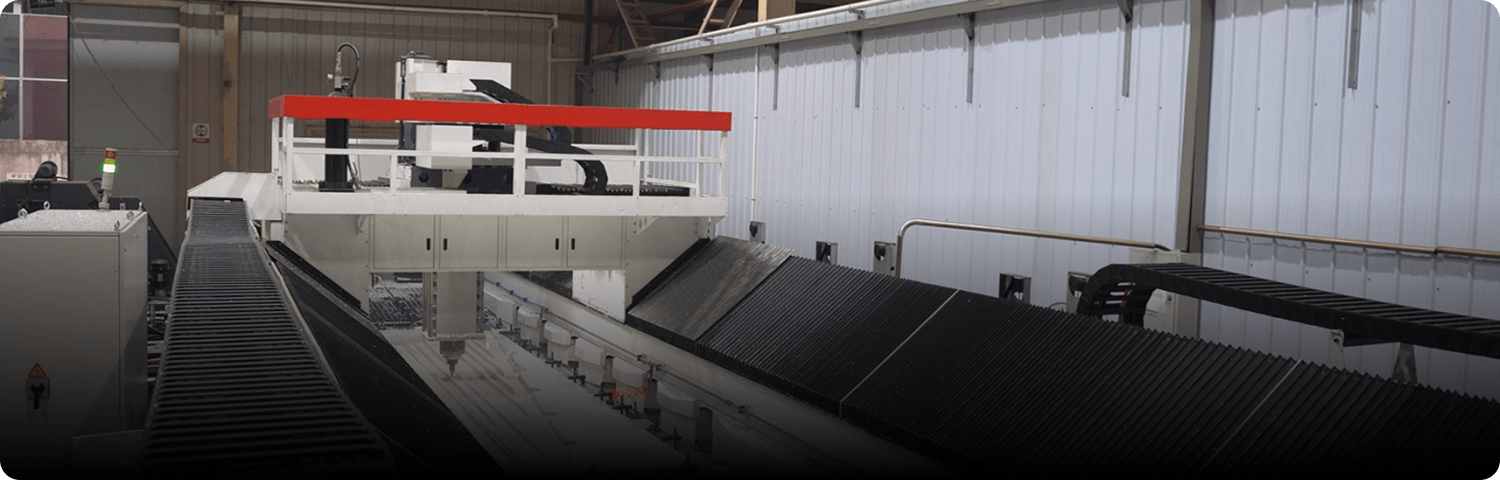
Fuxing Technology selected the Tiz3020 titanium-dedicated 5-axis gantry mill for this job — the same machine's high-rigidity BT50 spindle, precision servo control, and high-pressure through-spindle cooling (on the Tiz3020) proved equally effective for Inconel. The key adaptations were:
Blade contour programming: UG/NX 5-axis simultaneous contouring with optimized lead/lag and side-cut angles to maintain constant chip thickness throughout the blade airfoil
High-pressure cooling: 15MPa through-spindle flood directed at the tool-workpiece interface — essential for Inconel to evacuate heat from the shear zone
Two-stage roughing strategy: HSM roughing (40% step-over, 2mm depth) followed by semi-finishing passes before final finish cuts — reducing residual stress without sacrificing cycle time
Tooling selection: CVD-coated carbide end mills (0.5mm corner radius) for finishing passes; diamond-coated tools for roughing — 8-piece tool kit per blisk
Optical CMM verification: ZEISS ATOS 3D optical scanner for full-surface profile deviation mapping — 10,000+ measurement points per blade airfoil
Results
All 6 blisks passed CMM inspection with 100% first-pass yield. Blade profile tolerance: ±0.018mm (better than ±0.030mm specification). Surface finish: Ra 0.65μm on airfoil sections (better than Ra 0.8μm spec). All 52 blades per disk passed fatigue-critical surface integrity requirements. CMM certification and AS9102 FAI documentation delivered with each piece. Customer placed a repeat order for a 50-piece production batch within 4 months

Feel free to reach out for any queries. We would be happy to help!
We Look Forward To Working With You.
Get In Touch

Feiyin Machine Tool
Contact Us
Sales Call: +86 025 8495 0091
Sales Call: +86 025 8495 0092
E-mail: 13585111064@163.com
WeChat: +86 135 8511 1064
Address:
